
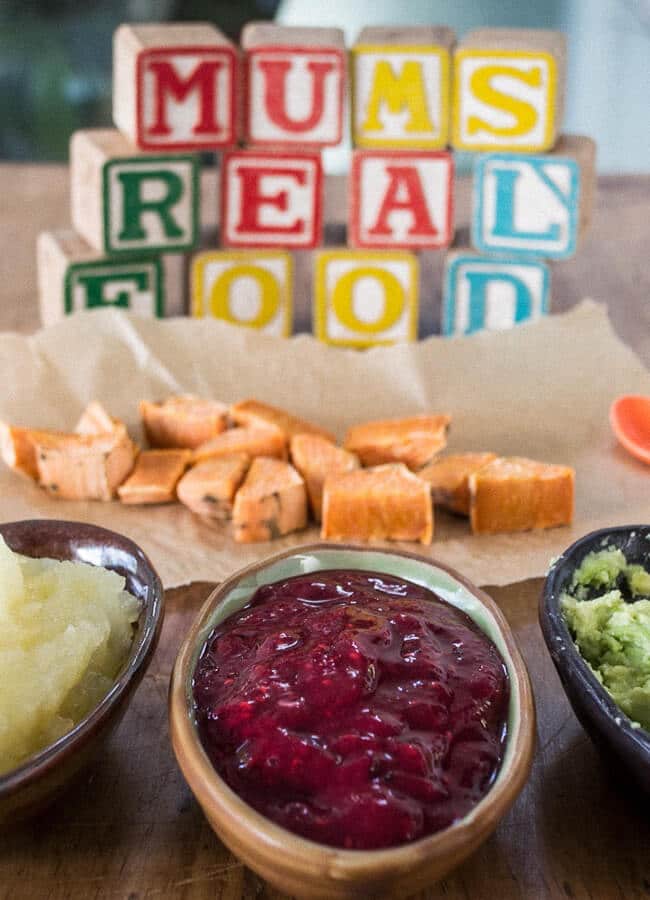
Over the next few months, I am going to post on specific foods including some basic but nourishing recipes. But first, I’m going to cover a few of the basics for preparing and preserving babies first foods.
I know to an adult, eating simple single foods pureed, is well, unappealing. But for a baby, entering the world of solids, simple single foods are nourishing and very grounding.
I discussed that feeding baby SLOW (Seasonal, local, organic and whole foods) is preferable in my last post. If you missed it you can catch up here. Even if not organic, please ensure that when choosing babies food, it is as fresh and ripe and possible.
Cooking babies food
Prepare food in very small batches. To cook such small quantities you will need a small stainless steel pot (about 15cm wide). Using small pots allows you to cook food in a small amount of liquid or stock and not dilute the taste of the food too much. Please don’t use non-stick pots. The risks associated with exposure to Teflon are magnified in babies tiny bodies. To read more about Teflon, click here.
Where possible, steam vegetables until just cooked through (try not to overcook them and lose all of the valuable nutrients). If baking, do so at a low temperature and until they are just cooked.
Use a small, mini food processor or stick blender to puree food. The Thermomix, because it is able to process very small quantities, is also great (wish I had one at this stage of my kids life).
Freezing
It is best to feed your baby food that has been freshly prepared. Fresh food provides nourishment that has it’s life force intact and is most easily digested. However, the freezer is a great asset to busy mums. Making up batches of foods and freezing in small containers or ice block trays is certainly next best to fresh (and a fantastic backup when your day goes pear shaped). Always freeze and store baby food in glass or BPA-free plastic containers (including ice cube trays).
Microwaving
I have always been sceptical about microwaving food. I have one, but only use it to heat up a wheat bag every now and then or dry out my moisture absorbing crystals (that stop my shoes going mouldy)! But mostly I use mine as a bread bin – a nice sealed container to keep my bread fresh!
There’re conflicting reports as to how microwaves affect food at a nutrient level. Some people say they actually preserve nutrients, others claim they destroy them and much more. This article makes sense to me and at a biochemical level, I simply can not get my head around the concept of microwaving my food. To read it click here. I personally prefer the time honoured method of cooking my food over a flame or exposing it to heat in a convection oven.
The biggest wake-up call I had with my microwave was when I had some little pots of micro herbs growing in my pantry. They were a good metre away from the microwave and had been surviving quite nicely for some time. But one day I microwaved my moisture absorbing crystals and within about 10 seconds, my herbs had shrivelled up before my eyes and died. If it affects living organisms that way – even at a distance, I refuse to put my food in there. I won’t even defrost my pets food in there (but I do love my pets).
If you really must microwave, please only do so in glass or ceramic, never plastic (and never covered with glad wrap) as this causes carcinogenic chemicals to transfer to babies food.
So how will I heat babies food?
I always defrosted cubes of food at room temperature in a small bowl and then sat the bowl in boiling water for a few minutes (like you would a baby bottle). Babies don’t need their food very hot, just a little above room temperature is fine. If it was straight from the freezer, I would place the bowl of food in the top basket of my steamer and steam it for a few minutes. This method involves no washing up and takes only a few more minutes than microwaving. When they are eating larger amounts, you may like to heat it in a little pot.
Any other ideas for preparing or time-saving tips are most welcome. Share what works for you with other mamas out there by posting a comment or question below.
Family Ad

Bel says
Hi Georgia, what pans do you recommend instead of teflon ones for cooking eggs, stir frys, etc? Thanks!
Georgia Harding says
I LOVE solidteknics brand. They are Australian made, inexpensive, durable, forever pans that will never wear out (cast iron and cast steel) – & they cook everything to perfection. You will need to season them regularly (to keep them non stick) but other than that, they are easy to wash and care for. Hope this helps G x
Lisa says
Hi Georgia, what kind of trays/containers do you recommend to store your baby food? Kmart have some great sized ice cube trays (larger than normal) but I worry about using plastic because of the chemicals.
Georgia Harding says
Yes – plastic, especially when exposed to extreme temps is a real worry for a tiny body especially. I’d recommend recycled small glass jars (we kept all our dijon mustard / horseradish jars, washed them and filled 3/4 to allow for expansion). They were’t available when my kids were babies, but I’d be investing in these stainless steel ice cube trays (link below) if I had a bub now. Expensive but you’d only buy once. I have their ice block moulds and they are awesome. Hope this helps G x
https://t.cfjump.com/15188/t/14846?Url=https%3a%2f%2fwww.biome.com.au%2fstainless-steel-homewares%2f4323-stainless-steel-ice-cube-tray-by-onyx-705105583204.html
Kristen says
Hi Georgia, what is your take on silicon for cooking. It’s reusable and easy care but i’m concerned about health of baby.
Kristen
Georgia Harding says
Hi Kristen. I personally don’t cook or freeze in silicon. I think it’s okay for say storing food (as a separator in the lunchbox) but I’m not convinced repeatedly exposing it to extreme hot/ cold temps. I do however use the ‘If you care brand’ of baking sheets occasionally which are silicon lined (but they are single use). So I think better than plastic, but glass/ stainless, cast iron are the best choices if available to you G x