
Chicken Tikka Masala is one of the most popular Indian-inspired dishes and for good reason. Juicy marinated chicken, grilled to smoky perfection, is simmered in a velvety, spice-rich tomato sauce. This version is simple to make at home and adaptable to suit your family’s preferences or dietary needs. Health benefits of homemade Chicken Tikka Masala…
indian
Chicken Tikka
This Chicken Tikka is packed with bold Indian flavours and makes a perfect fuss-free meal your family will love. While traditionally cooked in a tandoor oven, it works beautifully on a barbecue or grill plate, bringing a touch of smokiness and char to the tender chicken pieces. Health benefits Chicken thigh is a rich source…
Lamb Saag (slow cooked)
Looking for a delicious and easy-to-make meal that will warm your heart and nourish your body? Look no further than this one pot, slow cooked Lamb Saag recipe. With tender lamb cooked to perfection in a flavourful blend of spices and fresh spinach, this dish is not only satisfying, but also incredibly healthy. Plus, it’s…
Chicken Jalfrezi
This traditional Chicken Jalfrezi is a warming, easy to make nourishing Indian curry. It has a tomato base and is packed with tender chunks of chicken and vibrant vegetables. The rich blend of spices creates a tantalising aroma that will have your taste buds tingling with anticipation. Whether you’re a seasoned curry lover or a…
Slow Cooker Sweet Potato Dhal
There are days when we are short on time and low on fresh ingredients! On those days, I make this Slow Cooker Sweet Potato Dhal. I always seem to have the simple ingredients on hand and it can be put on to slow cook around lunchtime so it doesn’t matter if I miss the early-morning-slow-cooker…
Slow Cooked Beef Madras
This Slow Cooked Beef Madras is a fabulous, nourishing one pot wonder. My kids aren’t fans of either eggplant or zucchini but in this dish, they pretty much disappear behind the curry flavour and thicken the curry base. Throw it all in your Dutch oven and wait for the flavours to develop. Time saving tip…
Indian Brisket
This pull apart Indian Brisket is a lovely set and forget meal. It’s a rich, flavoursome meal that is delicious paired with the zesty slaw and yoghurt. Brisket is the perfect meat for a slow cooker. It needs to be cooked ‘low and slow’ to tenderise the meat and the longer time develops the depth…
Indian Mulligatawny Soup
This Indian Mulligatawny Soup is an immune supportive meal in a bowl that is really delicious and super easy to make. It is a flavoursome spiced soup, thick from the lentils and rice that have been simmered until soft. The vegetables are mostly broken down by the cooking so you have a hearty meal full…
Tandoori Chicken Drumsticks
Tandoori Chicken is probably one the most loved Pakistani BBQ items. These Tandoori Chicken Drumsticks are an easy to make and a budget friendly meal. This is also a perfect recipe to double. Drumsticks in the lunchbox are an awesome source of protein and to help prevent sticky fingers, you can wrap the end in…
Indian Spiced Lamb Shoulder
This delicious, melt-in-your-mouth Indian Spiced Lamb Shoulder is a meal I know you’re going to love. It takes about 5 minutes of prep, then it’s slow cooked in the oven to create the tastiest meal. With Father’s Day just around the corner, this is a fabulous ‘roast’ for dad for lunch or dinner. My hubby…
Indian Baked Veggies
This delicious Indian Baked Vegetables brings the warmth and aroma of Indian spices onto your table. It is quick and easy, combining three vegetables for a tasty side or salad (or a meal for 2). I love combining roasted vegetables, spices and fresh leafy greens into a side dish to accompany a grilled protein. It’s…
Spiced Carrot and Coconut Salad
This spiced carrot and coconut salad is a simple yet delicious dish that pairs beautifully with a range of meals. In Sri Lanka, curries are always served with various accompaniments which compliment their flavour. This zesty Spiced Carrot and Coconut Salad is somewhere between a ‘sambol’ and a ‘mallung’ and the perfect side for any…
Heathy Lamb Korma with Spiced Cauliflower Rice
This slow cooked Healthy Lamb Korma with Spiced Cauliflower Rice is one of my favourite ways to eat lamb. Despite the long list of ingredients, this dish is actually very easy to make and is a beautifully spiced, delicious meal. It’s also a great curry to introduce to young kids as there’s no heat. For…
Lamb Coconut Curry
This weeks cracking Lamb Coconut Curry recipe is thanks to the lovely Irena Macri from Irena Macri | Food Fit For Life. I don’t often share other peoples recipes, but Irena is a friend and I really love her cooking style.
This Lamb Coconut Curry is a rich, delicious dish with tender lamb, warming spices, and a creamy coconut milk base. It’s perfect for a hearty, comforting meal, with a balanced combination of protein, healthy fats, and vibrant flavours from the herbs and spices.
Health benefits
Lamb is a great source of high-quality protein, rich in vitamins like B12, which supports red blood cell production. The spices used, like turmeric and fennel seeds, offer anti-inflammatory benefits, while coconut milk provides healthy fats to nourish and satisfy.
Ingredients
This recipe combines diced lamb shoulder, onions, cloves garlic, and celery with fragrant spices such as garam masala and turmeric. Coconut milk forms the rich base, while vegetables like carrots and fresh coriander add texture and freshness. Optional variations make it adaptable to different dietary preferences.
How to make this lamb coconut curry
Start by browning the lamb in your choice of fat, then soften the onions, celery, and garlic with spices. Add coconut milk, tomato paste, water, and sea salt, then slow-simmer for an hour. Add the diced carrots and continue cooking until tender. A final touch of lime juice and fresh coriander brings everything together.
Serving suggestions and how to store
Serve this curry with cauliflower rice, basmati rice or your favourite vegetables for a nourishing meal. It can be stored in the fridge for up to 3 days or frozen for longer-term storage. Reheat gently on the stovetop before serving.
Vary this lamb coconut curry to suit your needs
To make it dairy-free, use coconut oil instead of ghee. For a no-heat version, simply omit the red chili. For a vegetarian option, swap the lamb for chickpeas and serve with rice or quinoa for a complete protein.
I’ve made this several times for my family and they always devour it. So here we have it, I know you are going to love this delicious Lamb Curry…
For more healthy curry recipes, click HERE.

Lamb Coconut Curry
This Lamb Coconut Curry is an easy to make, nourishing curry that the whole family will love.
Servings: 4
Ingredients
- 1 tbsp butter, ghee or coconut oil
- 700 g lamb shoulder - diced
- 1 onion/s (large) sliced
- 1 red chilli/s - finely diced
- 2 stick/s celery - diced
- 3 clove/s garlic - diced
- 2 ½ tsp garam masala
- 1¼ tsp ground turmeric
- 1 tsp fennel seeds
- 1½ tsp ghee (or extra coconut oil)
- 400 ml canned coconut milk (1½ cups)
- 1½ tbsp tomato paste (omit for AIP)
- 250 ml water (1 cup)
- 1 tsp sea salt - or to taste
- 2 carrot/s - diced
Serve
- ½ lime/s - juice (to serve)
- Fresh coriander or parsley - to garnish
- Rice, quinoa or cauliflower rice (to serve)
Instructions
- Heat a tablespoon of butter, ghee or coconut oil in a casserole dish or a large saucepan.
- Add the lamb and stir on a high heat until slightly browned, about 3-4 minutes.
- Add the onion, chilli and celery and cook for about a minute or two, until slightly softened. Bring the heat down to medium.
- Add the garlic, garam masala, turmeric, fennel seeds and ghee (or extra coconut oil if avoiding dairy). Stir through and cook for a minute to let the spices release their aromas.
- Add the coconut milk, tomato paste, water and sea salt. Stir and bring to boil.
- Turn the heat down to slow simmer and cook for 1 hour, covered with a lid. Stir a couple of times.
- After an hour, add the diced carrot and cook for a further 30-40 minutes, covered with a lid. Stir a few times.
- Sprinkle with some fresh coriander or parsley and a little drizzle of lemon or lime juice before serving.
Serve
- Serve with your favourite vegetables or rice, cauliflower rice or quinoa.
Slow cooker
- This can certainly cooked in a slow cooker. However, as the speed and temperature varies between the many brands of slow cookers, base the amount of liquid you add and the cook time on a similar style of recipe in the guide book for your specific slow cooker. The general rule of thumb is to halve the liquid and double the cook time, but understanding your own slow cooker is the best guide.
Make-ahead
- Re-heat in a pot over a low heat until just hot.
Store
- Store in an airtight container in the fridge.
- Can also be frozen.
Grab Bag Formula Method
- If you've done the **Grab Bag Formula Short Course, this is the method to convert this recipe...
- Place all your prepared ingredients into the Grab Bag.
- Carefully seal your Grab Bag. I close most of the seal then press out as much air as I can then complete the seal. Place the Grab Bag in the freezer.
- To cook, remove the Grab Bag from the freezer, place on a baking tray and thaw in the fridge overnight.
- Tip the contents of the Grab Bag into a large oven proof dish (with a tight fitting lid) or Dutch oven. It may still be a bit frozen; that’s okay. Place the lid on the pot, set your oven to 150°C/300°F (fan-forced) and cook for 4½ hours.
- Taste and adjust the seasoning and spiciness. Sprinkle with some fresh coriander or parsley and a little drizzle of lemon or lime juice before serving.
- ** The Grab Bag Formula Short Course is available to purchase for just AU$46 HERE.ORIf you are a full-access Well Nourished Family member, the course is included in your membership and you can access in the members portal - HERE.
Notes
No-heat
Remove the red chilli to make it less spicy if cooking for the kids - although it’s not very spicy anyway.Dairy-free
Choose coconut oil as the fat.Onion and garlic-free
Replace them with a small bulb of fennel (diced) and a teaspoon of ground cumin.Vegetarian
Replace the lamb with 2 cans of drained and rinsed chickpeas. Serve with rice or quinoa to ensure you have a complete protein.Let me know if this is a winner in your household. Post a comment and rate the recipe below.
Potato Pea Spinach Curry
Potato Pea Spinach Curry is a comforting and versatile dish that’s packed with flavour and is a wonderful addition to your meal rotation. Serve it as a standalone dish or pair it with rice or flatbread for a complete meal.
It’s no secret I’m a huge fan of Indian cuisine. This mild curry brings back memories of breakfast on the beach in Goa, India. This was our staple as we finished-up our backpacking adventure pretty much broke, but milking our last days of travel in a make-shift hut on a gorgeous secluded beach in the south of India. Every morning we ate a potato curry of sorts for brekkie firstly because it was delicious and what the locals were eating, but also it was a dirt cheap, filling start to the day.
These days, far removed from that blissful beach, I make this often as a side dish in the hope there will be left overs for the next days breakfast along with with food memories to deliver me back to India, with sand between my toes.
For lots more sides and salad inspo, take a look at my hugely popular ebook ˜Well Nourished Sides and Salads’– where vegetables become the hero of the dish! It’s great value at just $9.95, click HERE to take a look.
Health benefits
This curry is rich in fibre, vitamins, and minerals. Potatoes provide energy and potassium, peas are a great source of plant-based protein, and spinach adds a boost of iron and antioxidants. Cooking with spices like turmeric and cumin enhances its anti-inflammatory and digestive properties.
Ingredients
This dish features aromatic spices like mustard seeds, cumin, and turmeric, combined with creamy potatoes, peas, and fresh spinach. A hint of lime and coriander brightens up the dish, making it both hearty and refreshing.
How to make potato pea spinach curry
Begin by sautéing onions in ghee, butter, or olive oil until softened. Add the spices to bloom their flavours, then stir in the diced potatoes, seasoning them generously. Cook until the potatoes are tender, then mix in the spinach and peas until just wilted. Garnish with fresh coriander and serve with lime wedges.
Serving suggestions and how to store
Serve hot, paired with steamed rice, quinoa, or flatbreads for a satisfying meal. Store leftovers in an airtight container in the fridge and reheat gently with a splash of water or broth.
Vary this potato pea spinach curry to suit your needs
For a vegan version, replace ghee or butter with coconut oil. Add protein by including diced paneer, chickpeas, or both. To make it onion-free, sauté fennel instead of onion for a similar sweetness and texture.
For more delicious, healthy vegetarian recipes, click HERE
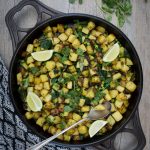
Potato Pea Spinach Curry
This Potato Pea Spinach Curry is a really easy to make, delicious curry side dish or main meal. It suits gluten, dairy, grain free and vegan.
Servings: 4
Ingredients
- 2 tbsp butter, ghee or olive oil
- 2 red onion/s -sliced
- 1 tbsp mustard seeds
- 1 tbsp cumin seeds
- 1 tsp ground cumin
- ¼ tsp ground turmeric
- 4 potato/s (large) peeled and cut to a 1.5cm dice
- 1 tsp sea salt - or to taste
- ground black pepper -to taste
- 60 ml water (¼ cup) or bone broth if you'd like to make it a bit more nourishing
- 1 cup/s baby spinach
- 75 g frozen peas (½ cup)
- ¼ bunch/s fresh coriander leaves -to serve
- 1 lime/s -cut into 4 wedges, to serve
Instructions
- In a large cast iron or non-stick pan, heat the ghee, butter or oil over a moderate to low heat.
- Add the onions and cook until softened (about 3-4 mins).
- Add the spices and cook for 1 min.
- Turn the heat up a little and add the potatoes to the pan, stirring well to coat in the ghee, onions and spices. Season well with the sea salt and pepper. Cook, stirring, until the potatoes start to caramelise on the outside.
- Reduce the heat to low. Add the water, cover and cook, stirring occasionally until the potatoes are cooked through. The potatoes are cooked when a knife passes through them easily.
- Once the potatoes are cooked add the peas and spinach and cook for one more minute until the spinach has just wilted.
- Top with the coriander leaves and serve with the lime wedges.
Make ahead
- Re-heat in a pot over a low heat until just hot. You may need to add a little water or stock to stop it sticking.
Store
- Store in an airtight container in the fridge.
Notes
Make a meal of it
Add in diced paneer (Indian cottage cheese available from supermarkets) or add a cup of chickpeas. Add both once the potato is nearly cooked.Vegan
Replace the ghee/butter with coconut oil.Onion-free
Replace the onion with one bulb of fennel, diced and sautéed (as with onion).What are your fondest food memories. Perhaps it's of a dish I could re-create with a healthy spin. Let me know by posting a comment below.
Indian Spiced Mince and Peas
I love Indian cuisine, especially this Indian Spiced Mince and Peas recipe – I’d go so far to say it is my favourite kind of food. So I was especially thrilled to see a curry on Jamie Oliver’s list of ’10 recipes to save your life’. In case you hadn’t heard, as part of Jamie Oliver’s Food Revolution, I was one of 10 people selected world-wide to put my spin on 10 of Jamie’s favourite staple recipes.
I’ve shared quite a few of my favourite Indian style curries already here on the website (Quick and Easy Dhal, Simple Vegetable Curry and my very popular Chicken and Almond curry) so I thought for this part of the challenge I’d share this really quick, budget friendly family favourite – my Indian Spiced Mince and Peas.
This Indian Spiced Mince and Peas dish is a quick, delicious meal that combines aromatic spices with juicy tomatoes, tender beef mince and sweet peas. It’s perfect for busy weeknights and can easily be served with rice, quinoa, or a low-carb alternative like cauliflower rice.
Health benefits
Beef mince provides a great source of high-quality protein and essential vitamins like B12, which is crucial for energy production and brain function. The spices (turmeric powder, ginger, coriander powder, garam masala) in this dish add anti-inflammatory benefits, while the coriander (cilantro) and peas boost its fibre and vitamin content.
Ingredients
This recipe calls for simple ingredients like beef mince (ground beef), garlic cloves, fresh ginger, onions, tomatoes, and fresh or frozen peas. A variety of spices such as cumin powder, garam masala, and coriander powder add rich, Indian-inspired flavours to the dish. The recipe also provides flexibility with add-ins like vegetables or different grains.
How to make Indian Spiced Mince and Peas
Start by sautéing onions in your choice of fat, then add garlic, ginger, and spices to bloom the flavours. Stir in the beef mince and tomatoes, cooking until the mince is browned. Add peas in the final minute to keep them fresh and vibrant, then garnish with fresh coriander before serving.
Serving suggestions and how to store
Serve with rice, quinoa, or cauliflower rice. It’s also delicious paired with a fresh leafy salad or steamed vegetables, and a dollop of natural yoghurt. A side of nann bread never goes astray too. Store leftovers in an airtight container in the fridge for up to 3 days, or freeze for longer storage.
Vary Indian Spiced Mince and Peas to suit your dietary needs
To make it vegetarian, replace the beef mince with canned brown lentils. For an onion and garlic-free version, use extra ginger to enhance the flavour. You can also add more vegetables to boost the nutritional value.
Take a look at the variations (below the main recipe) for suggestions to alter the recipe to suit any specific dietary requirements.

Indian Spiced Mince with Peas
Dinner won't get any more budget friendly, easier or tastier then my Indian Spiced Mince with Peas. This is one meal sure to go on regular rotation. Gluten, grain and dairy-free.
Servings: 4
Ingredients
- 30 g butter, ghee or coconut oil (2 tbsp)
- 1 onion/s (large) chopped
- 2 clove/s garlic - chopped
- 1 tbsp ginger root - peeled and finely grated
- 2 tsp ground coriander
- ½ tsp ground turmeric
- 1 tsp ground cumin
- 1 tsp garam masala
- 1 tsp sweet paprika
- 1 tsp sea salt - or to taste
- chilli flakes - to taste (optional)
- 500 g beef mince
- 4-5 roma tomatoe/s - roughly chopped
- 150 g peas (1 cup) fresh or frozen
- ¼ bunch/s fresh coriander leaves - to serve
Serve
- Rice, quinoa or cauliflower rice (to serve)
Instructions
- In a large frypan or wok, heat the butter, ghee or coconut oil and sauté the onion over a medium heat for a few minutes to soften.
- Add the garlic, ginger and spices and fry, stirring well for about a minute.
- Now add the mince and tomatoes and stir-fry until the mince is cooked.
- Add the peas and cook for a minute or two. Stir through the coriander and serve immediately.
- Taste and adjust the seasoning if necessary.
Tip
- Other vegetables can be added to the mix when stir frying. Cut them small so they cook quickly with the mince.
Serve
- With rice or cauliflower rice (pictured here).
- I also serve with a leafy salad or steamed vegetables.
- It's lovely with a dollop of natural yoghurt too.
Make-ahead
- Re-heat in a pot or wok over a low heat until just hot.
Store
- Leftovers are great for school lunches (in the thermos) or even wrapped in a fresh spring roll.
- Store in an airtight container in the fridge.
- Can also be frozen.
Notes
Different or more vegetables
Go ahead - it's a great base to add to.Onion and Garlic-free
Replace the onions and garlic with and extra 2cm's of ginger.Vegetarian
Replace the mince with two cans of brown lentils (drained and rinsed). Serve with rice or quinoa to ensure you have a complete protein.I'd love for you to share how you like this delicious, super simple recipe. Post a comment below or rate this recipe.
Indian Vegetable Curry
This Indian Vegetable Curry is a versatile dish that’s packed with flavour. The blend of spices, cashews and yogurt makes for a rich creamy curry that pairs perfectly with any vegetables you have on hand. You can also freeze batches of the sauce for a quick curry another time. Vegetarians this is the ultimate mixed vegetable curry.
Health benefits
Anything with this many veggies is always going to be full of nutrition and gut loving fibre! Coupled with so many wonderful anti-inflammatories, digestion and immune supporting anti-inflammatory spices; protein and essential fatty-acid rich cashew nuts, this is not only really delicious but supports optimal health and healing.
Ingredients
This gluten-free Indian vegetable curry recipe features aromatic spices like fennel seeds, cumin, turmeric, coriander, and garam masala. Combined with fresh vegetables, cashews, tomatoes, and yogurt, it creates a delicious curry sauce that’s adaptable to your preferences.
How to make this vegetarian curry
To make this veg curry begin by sautéing the onions, garlic, ginger and spices (fennel seeds, cumin powder, coriander powder, turmeric and garam masala) over a medium heat until fragrant. Blend this with cashews, tomatoes, yogurt and water (or vegetable broth) to create the creamy base. Then, simmer the vegetables in the sauce, adding them in stages based on their cooking time. For a time-saving method, steam or roast the vegetables and stir them into the sauce. Garnish with fresh coriander leaves (fresh cilantro) to serve.
If you own a Thermomix, we’ve also included Thermomix instructions for this recipe.
Serving suggestions and how to store
Serve this Indian Vegetable Curry with brown basmati rice, quinoa, or cauliflower rice. I love serving with naan bread too. For added variety, try it with a poached egg for breakfast. Leftovers can be stored in the fridge for up to 3 days or frozen for longer storage.
Vary this Indian vegetable curry to suit
For a dairy-free or vegan option, swap the yogurt for coconut milk. If avoiding onions, use fennel instead. You can also add chickpeas or lentils for extra protein, or incorporate chicken or fish if you prefer a meat version. Adjust the spice level by adding chilli flakes or serving with fresh red chilies for customised heat.
Take a look at the variations below for all the details as well as suggestions to alter the recipe to suit your specific dietary requirements.

Indian Vegetable Curry
This Indian Vegetable Curry really easy to make, mild curry that the whole family will love. It's also super versatile so you can adapt it to suit your taste.
Servings: 4
Ingredients
- 1 tbsp butter, ghee or coconut oil
- 1 onion/s (medium) peeled and diced
- 2 clove/s garlic -peeled and diced
- 1 tsp ginger root -peeled and finely grated
- 1 tbsp fennel seeds
- 1 tbsp ground cumin
- 1 tsp ground turmeric
- 1 tbsp ground coriander
- 1 tbsp garam masala
- 150 g raw cashew nuts (1 cup)
- 5 vine ripened tomatoe/s -roughly chopped
- Sea salt and freshly ground black pepper -to taste
- 250 g natural, Greek or coconut yoghurt (1 cup)
- 180 ml water (¾ cup) or vegetable broth
Vegetables I used - see note below
- 1 sweet potato/s (small)
- 1 carrot/s (large)
- 1 red capsicum/s
- ½ cauliflower
- ½ broccoli
- 30 g baby spinach (1 cup)
- ½ cup/s peas -fresh or frozen
Serve
- Rice, quinoa or cauliflower rice (to serve)
- ½ bunch/s fresh coriander leaves
Instructions
Note
- You can chose any vegetables you like with this curry. Try to cut your root vegetables to roughly the same size and group vegetables into approx. cook times. So in this case, the carrot and sweet potato will take the longest so I add them to the sauce first, followed by the red capsicum, cauliflower, broccoli and lastly, I stir in the spinach to wilt. The cook time will depend on the size you have cut your vegetables. I like a fairly chunky curry, which is easier to cut up but takes a bit longer to cook than if you cut the vegetables smaller. Your call.
- In a large, deep pan, melt the ghee, butter or coconut oil and sauté the onion, garlic, ginger and spices over a low heat unit the onion is just starting to become opaque and the spices smell amazing.
- Transfer this to a blender or food processor with the cashews, tomatoes, sea salt, yoghurt and water and blend until it is smooth.
- Add it back to the pan you cooked the onions and spices in (no need to wash it), add your vegetables in stages (see the note above), and simmer with the lid on (it will spit), stirring frequently until the vegetables are cooked to your liking. Taste and season again (salt is really important to bring the flavour of the spices out so make sure you season well).
- My curry takes approx. 15 minutes for the root vegetables and another 5-10mintes for the quick cooking veggies (broccoli, cauliflower and capsicum). Always add leafy greens (baby spinach/coriander) at the very end once you have turned off the heat.
- Another way to cook this curry is to steam (or roast) the vegetables and just mix through the sauce (which has simmered 10-15 minutes to build flavour).
Thermomix Method
- Place your onion, garlic and ginger (also fresh turmeric if using) in your TMX and process 3 seconds, speed 6. Scrap the sides. Add the fennel seeds, cumin, turmeric powder, coriander seeds and garam masala and ghee, butter or coconut oil and sauté 3 minutes, temp 100, speed 1.
- Add the cashew nuts, sea salt and tomatoes and blend 20 seconds, speed 7.
- Add the yoghurt and water and blend 1 minute, speed 8.
- At this point, you can choose to cook your curry in a stove-top pot (point 3 above), or continue in your TMX. Personally, I like to finish this in a pot as I find the vegetables stay more intact than cooking it in the TMX. See the note above re-cook time. If you do choose to cook your vegetables in the TMX, make sure the blade is on reverse and cook at temp 100, speed 1 (cook times will vary as explained above).
- Taste and season again (salt is really important to bring the flavour of the spices out so make sure you season well).
- If you are using the steamed method (point 5 above), cook for 10 minutes, temp 100, speed 3 before pouring over your vegetables.
Serve
- This is lovely served with brown basmati, quinoa or cauliflower rice.
- Garnished with fresh coriander leaves.
Make-ahead
- Re-heat in a pot over a low heat until just hot.
- Leftovers are great for breakfast with a poached egg.
Store
- Store in an airtight container in the fridge.
- Can also be frozen (either the sauce alone or with the vegetables).
Notes
Dairy-free and vegan
Sub the yoghurt with coconut milk.Onion-free
Replace the onion with a small bulb of diced fennel.Garlic-free
Increase the ginger to a 4cm piece to replace the garlic.Add a legume
Feel free to add in cooked chickpeas or lentils.Add meat
You could also add meat to this curry sauce – I’d suggest it’s best suited to chicken or fish.Make it spicy
Add dried chilli flakes at part one of the method. Or, serve with fresh or dried chilli so everyone can control their own heat (this is what we do).Hope you enjoy this very versatile curry. Love to hear how you like it or post a question in the comments below.
Healthy Pumpkin Soup – four ways
This healthy Pumpkin Soup recipe is a super comforting dish that you can whip up in no time. The best part? You can easily change it up with four different flavour variations: Thai, Ginger, Indian, or Pumpkin and Bacon. It’s rich, creamy, and perfect for warming you up on a chilly day, plus it’s versatile enough to suit different tastes and dietary needs.. The variations are all SO good, it’s hard to pick a favourite.
Health benefits
Pumpkin is a wonderful source of dietary fibre and a powerhouse of vitamins and minerals. It contains many antioxidants, particularly beta-carotene which is essential for maintaining the integrity of the skin and mucous membranes and essential for optimal vision and immune health. Beyond this, it is very versatile and makes a cracking soup base. The bone broth will support you gut and immune system (to catch up on the benefits of bone broth, click here)
If your kids don’t like pumpkin
My kids really don’t like pumpkin, but they love my healthy pumpkin soup. I find if you pick a flavour variation that appeals to your child. For example, if you’re child loves bacon, chances are they’ll like the bacon version.
Ingredients
With just a few basic ingredients like pumpkin, onion, garlic cloves and broth or stock, this soup is simple yet delicious. You can swap out the stock for a vegetarian or vegan option, and the coconut milk adds a lovely creaminess without any dairy.
How to make healthy pumpkin soup
Start by sautéing your onion and garlic in butter or oil, then add the pumpkin and stock. Let it simmer until the pumpkin is soft and falling apart. Blend it up until nice and smooth (with a immersion blender or processor). if you’re making the Thai, Ginger, or Indian versions, add the coconut milk for an extra layer of flavour. It’s easy, quick, and can be adapted with different spices or ingredients depending on your mood. Seasoning it to taste with sea salt and black pepper really brings out the flavour. If you own a Thermomix, we’ve also included Thermomix instructions for this recipe.
Serving suggestions and how to store
Serve this soup with a side of crusty bread or a fresh green salad for a full meal. If you have leftovers, store them in an airtight container in the fridge or freezer. It reheats beautifully on the stovetop, making it a great option for meal prep or quick lunches.
Vary this healthy pumpkin soup to suit your dietary needs
To make this soup vegan or vegetarian, simply use vegetable broth or stock and olive oil. For a Thai twist, add curry paste and garnish with fresh herbs. The Indian version brings warming spices like garam masala and cumin to the mix, while the Pumpkin and Bacon version offers a smoky, coconut-free option. You can even add extra veggies like carrot or sweet potato to boost the nutritional content.

Pumpkin Soup - four ways
This wholesome basic soup can be eaten as it is or spiced up into an extra special dish. For those who generally dislike pumpkin, give the variations a try...you may be pleasantly surprised!
Servings: 4
Ingredients
- 2 tbsp butter, ghee or coconut oil
- 1 onion/s -roughly diced
- 2 clove/s garlic -roughly sliced
- 1 kg pumpkin -peeled and roughly diced into 2-3cm cubes (or a piece of a larger pumpkin)
- 750 ml chicken broth or stock (3 cups) or vegetable stock
- 270 ml canned coconut milk (1 cup)
- Sea salt and freshly ground black pepper - to taste
Instructions
- In a large pot, over a medium heat add butter or oil then gently sauté the onion and garlic for a minute or two until translucent.
- Add the pumpkin and stock, bring to the boil then simmer until the pumpkin starts to fall apart.
- Allow to cool a little before processing in a blender or food processor until smooth. Taste and season.
- If you are making the Thai, Ginger, or Indian version, add the coconut milk and mix or blend the soup.
Thermomix method
- Chop the garlic, 5 sec, speed 5. If adding extras like ginger, add with the garlic.
- Add the onion, chop 5 sec, speed 5. If making the bacon version add the bacon with the onion.
- Add the butter, ghee or oil and saute 2 mins, 100, speed 1.
- Add the pumpkin and chop, 10-15 seconds, speed 7.
- Add the stock and cook 15 mins, 100, speed 3 (with basket over the lid).
- Allow to cool a little before adding the coconut milk and puree (taking care it's cool enough) 30 seconds, speed 8.
Make-ahead
- Re-heat in a pot over a low heat until just hot.
Store
- Store in an airtight container in the fridge or freezer.