
• Skip to primary navigation
  • Skip to main content
  • Skip to primary sidebar
  • Skip to footer

Well Nourished HomepageWell Nourished

Simple recipes, whole foods, inspired health

  • Family Members
    • Recipe Filter
    • Quick Access Shopping List
    • Membership Tutorials
    • How to be Well Nourished
    • About Well Nourished
    • Where to Shop and what to Buy
    • FAQ
  • Family Members
    • Meal Plans
      • G’s Spring Meal Plan
      • G’s Autumn Meal Plan
      • My Weekly Planner
      • Quick Access Shopping List
      • Ingredient Alert
      • Prep Ahead Plans
      • Hosting Event Plans
      • Wellness & Health Plans
    • Recipe Filter
    • Courses & Community
    • Tips for family’s
      • Getting Kids On-board
      • Planning for Picky Eaters
      • New to Meal Planning
      • Meal Planning Tips & Tricks
    • Nourishing Resources
    • Members Offers
    • What’s New This Week
    • Events
    • Membership Tutorials
    • About Well Nourished
    • FAQ
  • Recipes
    • Meals
      • 30 Minute Meals
      • Budget Friendly
      • Chicken & Turkey
      • Fish & Seafood
      • Freezable Meals
      • Make-ahead Meals
      • Meat
      • Pasta and Noodles
      • Pork recipes
      • Slow Cooked
      • Vegetarian
    • Sweet Recipes
      • Baked Sweets
      • Desserts
      • Ice-blocks
      • No-bake Sweets
    • Breakfast
    • Healthy Lunchbox
    • After School Snacks
    • Savoury Snacks
    • Sides & Salads
      • Salads
      • Side Dishes
    • Soups
    • Drinks & Smoothies
    • Dips
    • Holidays & Entertaining
    • Sauces & Dressings
    • Sourdough Baking
    • Fermenting
    • Staples
    • Members only
    • Members only
  • Shop
    • Membership and Programs
    • Ebooks
    • Free Stuff
  • Affiliates
  • About
    • About Well Nourished
    • Testimonials
    • Join the Family
    • FAQ
  • Resources
    • Find a Practitioner
    • Find whole food
      • ACT
      • NSW
      • NT
      • SA
      • QLD
      • TAS
      • VIC
      • WA
    • Products and Services I Value
    • Whole foods pantry list
    • Ingredients Glossary
  • Wellness Hub
    • Inflammation
    • Perimenopause & Menopause
    • Healthy Kids
      • Healthy Baby
      • Healthy Toddler
      • Healthy Child
      • Immune support for kids
      • Digestion & Food Allergies
      • Healthy Lunchboxes
    • Budgeting & Planning
    • Digestion & Intolerance
    • Immune Health
    • Food as Medicine
    • Foods to Avoid
    • Healthy Habits
    • Sugar
    • Carbs, Protein, Fats
      • Carbohydrates
      • Fats
      • Protein
    • Healthy Food Choices
    • Healthy Home
    • Stress & Mood Disorders
    • Healthy Mind
    • Maternal health
    • Health Challenges
  • Login
    • Well Nourished Family
    • Courses & Community
    • Affiliate Login
  • My account

vegetable

Pumpkin Lasagne (with lots of twists)

June 4, 2015 | Budget Friendly, Make-ahead Meals, Pasta and Noodles, Freezable Meals, Vegetarian

My kids really don’t like pumpkin by itself (baked or steamed) – but they love it in soups (my favourite four recipes here) or in a lasagne or bake.  So today I thought I’d share my veggie packed, creamy Pumpkin Lasagne.

This pumpkin lasagne is packed with layers of flavour, combining roasted veggies, spinach, feta, and a rich tomato sauce. It’s a delicious, nutrient-dense twist on the classic lasagne, perfect for a cozy family dinner, and easily adaptable for various dietary preferences. This is a really versatile recipe, so customise it to suit your family.

Health Benefits

This lasagne is a fibre rich, supercharged veggie bonanza, including lots of different coloured vegetables. The hero of this dish – pumpkin, is a rich source of antioxidants especially vitamin A and many other vitamins, minerals and protective phytochemicals. With the option to go gluten-free, dairy-free, or grain-free, this lasagne is a nutrient-rich meal that can suit almost any dietary need.

Ingredients

This pumpkin lasagne recipe features a roasted pumpkin and vegetable base, mixed with quark or ricotta, spinach blended with feta, and a simple tomato layer. Whether you’re using fresh lasagne sheets or zucchini ribbons, you’ll layer up for a wholesome and hearty dish.

How to make this Pumpkin Lasagne

Start by roasting the pumpkin, carrots, cauliflower, onion, and cloves garlic until soft, then blend into a smooth puree. Sauté spinach, onion, and garlic, blend with feta, and then begin layering your lasagne with pasta or zucchini, alternating between the pumpkin and spinach mixture. Top with tomatoes and parmesan before baking.

If you own a Thermomix, we’ve also included Thermomix instructions for this recipe.

Serving suggestions and how to store

Serve your pumpkin lasagna with a fresh green salad for added crunch. If you want perfect slices, chill it first, slice and then reheat when needed. Store leftovers in an airtight container in the refrigerator or freezer for easy reheating.

Vary this pumpkin lasagne to suit your dietary needs

To make this dairy-free, use nutritional yeast instead of parmesan, and swap quark and feta with cashew nuts. For a gluten- or grain-free option, choose gluten-free pasta sheets or use zucchini ribbons. You can also make this egg-free or vegan by following the suggested swaps!

Check out the variations below the main recipe for tips on how to adapt it to your specific dietary needs.

Explore more delicious, easy to make vegetarian meals HERE.

Or a good variety of lasagne recipes HERE.
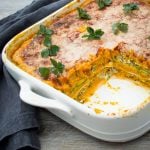
Pumpkin lasagne - Pumpkin Lasagne (with lots of twists) - this vegetable loaded lasagne is quick and easy to make. Includes variations for vegan, dairy, egg and gluten-free.
Print Recipe
4.79 from 56 votes

Pumpkin Lasagne (with lots of twists)

My favourite vegetarian meal, this Pumpkin Lasagne is a plant powered, delicious delight. Even though it has a few layers, it really is simple to make and worth every minute of prep. 
Prep Time20 minutes mins
Cook Time1 hour hr 10 minutes mins
Total Time1 hour hr 30 minutes mins
Course: Main Course
Servings: 6

Ingredients

Pumpkin layer

  • 1 kg pumpkin (butternut or Jap) peeled and roughly sliced
  • 2 carrot/s (large) roughly cut
  • 200 g cauliflower (1½ cups approx.) florets broken apart
  • 1 onion/s -peeled and sliced
  • 2 clove/s garlic -peeled and sliced
  • 1 tsp sea salt - or to taste
  • ground black pepper -to taste
  • 50 g butter, ghee or olive oil -melted
  • 120 g quark or ricotta cheese (½ cup)
  • 2 egg/s
  • 100 g parmesan cheese (1 cup) finely grated (though only half of this will go in the pumpkin puree, the rest is for the top)

Spinach layer

  • 50 g butter, ghee or olive oil -melted
  • 1 onion/s (large) peeled and diced
  • 1 clove/s garlic -peeled and crushed
  • 300 g baby spinach -washed
  • 100 g feta cheese -or goats feta

Tomato layer

  • 400 g diced tinned tomatoes
  • 1 tbsp dried oregano

Pasta layer

  • Fresh lasagne sheets - regular or gluten-free (or for grain-free, use a large zucchini, cut into ribbons) I have also layered both to increase the veggie content.
Metric - US Customary

Instructions

  • Preheat your oven to 180°C/350°F (fan-forced).
  • In a baking tray combine the pumpkin, carrots, cauliflower, onion, garlic and fat of your choice and toss together. I use the baking dish I plan to bake the final lasagne in (saves on washing up).
  • Bake for approximately 30 minutes or until the vegetables are soft (cooked through but not overcooked).
  • Whilst they are baking make your spinach layer by sautéing the onion and garlic in the pan with a little butter, ghee or coconut oil over a low heat until they start to soften (but not brown). Add the spinach and cook for a few minutes until the spinach wilts. Remove from the heat and place in a food processor (include any water from the wilting) with the feta or goat feta, and puree well. Set aside.
  • Once your vegetables are baked, allow to cool a little and then puree in a food processor with the quark or ricotta, eggs, half the parmesan and more seasoning if required. The consistency should be just runny enough to pour (so the lasagne doesn't end up too dry as the pasta sucks up moisture when cooking). If it is very thick add a little splash of water and process again.
  • Mix the oregano in with the tomatoes (I just add it to the can and gently mix).
  • Now arrange the lasagne using your chosen sheets of pasta or ribbons of zucchini.
  • Grease the baking dish and layer pasta (or zucchini), followed by a third of the pumpkin, pasta, half the spinach and repeat. Finish with the last third of pumpkin puree, followed by all of the tomatoes and top with the remaining parmesan cheese.
  • Bake for approximately 30-40 minutes or until brown on top and the pasta is cooked through.
  • Lasagne is always easiest to slice once chilled. If it is important to have nice neat slices, chill and then slice and then re-heat. Otherwise, serve immediately.

Thermomix Method

  • Grate the parmesan (10 seconds, speed 8). Set aside.
  • Follow step 1, 2 and 3 above.
  • For the spinach layer, chop the onion and garlic (3 seconds, speed 5). Scrape down the sides and add the fat of your choice (cook 3 minutes, temp 80, speed 1).
  • Add the spinach (cook 3 minutes, temp 90, speed 2).
  • Finally, add the feta and puree (10 seconds, speed 5). Set aside.
  • Without washing the bowl, puree your pumpkin mix (20 seconds, speed 5). Add half of the parmesan the quark, eggs and puree again (20 seconds, speed 6). Taste and season again if required.
  • Go to step 6 above, to finish.

Time saving tip

  • If you're not bothered about layers, you can combine the spinach and pumpkin to save time. Just add the onion and garlic (from the spinach layer) in the baking dish with the pumpkin/veggies and then puree all together with the spinach (raw is fine) and cheeses or DF options)

Serve

  • With a leafy green salad.

Make ahead

  • Re-heat in a low oven until just hot.

Store

  • Store in an airtight container in the fridge. I store it in a rectangle shaped oven proof glass pyrex or glass lock container so I can simply remove the lid and reheat in the storage container (saves washing up).
  • Can also be frozen.

Notes

Dairy-free

Sub the parmesan with the same amount of nutritional yeast and a good pinch of sea salt. Sub the quark for  ½ cup of cashew nuts (preferably soaked and throw them in with the vegetables to toast) and the feta for ¼ cup of cashew nuts (soaked) and a good pinch of salt. Top with chopped walnuts (and the other half of the nutritional yeast) instead of the parmesan.

Gluten and grain-free

Use gluten-free pasta sheets or for grain-free use zucchini. I often alternate pasta/zucchini.

Egg-free

Omit the eggs, it is still delicious, just not as firm. The lasagne in the photo is egg-free.

Vegan

Combine dairy-free and egg-free versions above.

Onion-free

Replace the onion with one large bulb of fennel, finely diced (and divided between the two layers).

Garlic-free

Replace the garlic with a teaspoon of cumin and a pinch of cayenne pepper. 


I'd love to hear how you like this family favourite. Post a comment and let me know (you could also simply rate the recipe).

A Closer Look at Processed foods – Is Margarine or Butter Healthier?

October 21, 2013 | Healthy Fats, Foods to Avoid, Carbs, Protein, Fats

Is margarine or butter healthier, I’m often asked? For me, it’s butter all the way and I’ll explain why.

This post is yes, about margarine (and spreadable butter, softened butter etc;) and how detrimental to your health they are. We move back into the territory of vegetable oils and why you really need to avoid consuming them. Just a bit more information following on from the recommendations I made on my post about fats and oils. If you’ve missed it you can catch up here.

Again with so many different varieties and brands, I have just picked some commonly found ingredients to analyse. Starting with the primary, and most concerning ingredient in all of these margarine and processed spreads…

Vegetable oil

Let’s just clarify that vegetable oils are technical, in fact, seed oils. The oil is extracted from the cheapest, poorest quality, often genetically modified seeds using high temperatures which make them rancid (stinky and off). When it seems the last drop of oil is extracted, chemicals are used to extract just a little more.

In order for a seed oil to be made solid (like butter) it then needs to be hydrogenated using a toxic heavy metal called nickel as a catalyst (or to put it simply, it’s chemically manipulated). This process produces a very dangerous form of fat called trans fats which are know to cause heart disease, cancer, infertility and have been implicated in many other degenerative disease (as they promote inflammation). Canola is the seed of choice in many margarines as its fatty acid structure means that is doesn’t require as much hydrogenation as other seed oils and therefore yields lower levels of trans-fatty acids. Regardless, the product ends up containing trans fats, for which there is no such thing as a safe amount (trans fats scare me more than any other ingredient in processed foods).

The end result of this process (I’ve read), is a smelly, dark grey/ brown chemical mess that needs to be deodorised and treated to be palatable.

Current dietary guidelines state that dietary fat (especially of the saturated kind) causes coronary heart disease, obesity (and therefore) type 2 diabetes. I can’t say it any better than David Gillespi in his book Big Fat Lies – “Apparently, some of the fat we eat causes our cholesterol to rise and since high cholesterol is a risk factor for heart disease, we should stop eating fat if we want to avoid that. However, the (scientific) evidence doesn’t support any of these claims about fat. It’s becoming increasingly clear that the things we use to replace dietary animal fat (usually sugar and seed oils) are likely to be the real cause of not just heart disease, but also of type 2 diabetes, cancer and obesity.”

NOTE – Seed oils are used in so much more than just making margarine. They are also used as cooking oils, in spreadable butter, salad dressings, mayonnaise, in cakes, pastries, crackers, sauces and many brands of bread. Also all fast food or commercial deep fryers use vegetable oils. Almost every fat we put in our mouths from processed foods is a seed oil. Prior to the industrialisation of our food chain, we survived on primarily animal-derived fats and coconut fats, (and also without the current rates of obesity and disease).

Is messing with the type of fat we have evolved to consume our undoing?

But back to margarine. The few other ingredients are…

Water and salt – no explanation required.
Emulsifiers (soy lecithin, 471) – 471 is a synthetically derived fat that helps to disperse water molecules through the fat.
Preservative 202 – Linked to liver damage, behavioural problems, asthma and recommended to avoid if you have kidney or heart problems.
Food acid (lactic) – no known side effects unless allergic.
Milk solids – skim milk powder used to colour the product.
Maltodextrin –  is made from treated or hydrolysed grain starch. It gives a fat like body to the margarine and extends its shelf-life.
Natural colour – (beta-carotene, curcumin or turmeric) –  Is used to turn a greyish brown like concoction yellow. Because they are described as natural doesn’t mean they are safe as many natural colours are associated with gene damage and risk to conception and cancer.
Vitamins A & D – mandatory fortification
Flavour – Information on this in not available.

To conclude…

Margarine is made by an industrialised, chemical process. Butter is made by churning cream or milk.  I can find no good reason to consume margarine (or any other softened butter or vegetable oil containing spread) – ever!

Usually, I follow up these posts with a healthy alternative recipe. Butter is so simple to make, especially if you have a high-speed blender or processor (like the Thermomix). Search online for very simple instructions on how to do so. Or, buy a butter preferably made from grass fed or organic dairy. Or just buy butter!

These few healthy alternatives, spreads or toppings are also worth a mention:

Avocado
Tahini
Nut butter like ABC (Almond, Brazil, Cashew spread)
Coconut oil
Coconut butter
Extra Virgin Olive oil (sprinkled with dukkah …mmmm)

Want to offload the seed oils in your cupboards? I hate waste, so how about using it to make a batch of play dough?

Want more like this?  
Other posts you may like to read are my previous post on Fats and Oils or Coconut oil.

I love to receive questions, post yours in the comments below.  Regardless of the health claims on the labels, nothing good comes from consuming any of the spreads or margarine in stores at present (had to say it just one more time)!

Primary Sidebar

Join the community

Social Media

Join over 140,000 followers

Nourish Your Inbox

Nourish Your Inbox!

Christmas Meal Planning Ebook

Sign up today for your FREE:
• Chocolate Ebook
• Subscribers Only Special Offers
• Practical Health & Nutrition Tips
• New Whole Food Recipes

WN App

Join the Family

Join the Family

Join The Family

The Well Nourished Family Membership is your complete solution to your families health and wellbeing. With 1200+ whole food recipes and SO MUCH MORE. Join for a limited time for over 80% OFF!

JOIN & SAVE 80%

Upgrade Your Membership – Recipe Only

Health Programs & Courses – Public

Health Programs & Courses

Health Programs & Courses

Whether you’re looking for effortless meal creation, lunchbox inspiration or strategies to raise adventurous eaters, our expert-led resources will guide you every step of the way.

Find Out More

Programs and Courses – FAM only

Affiliate promo – public

Become an Affiliate

Looking to partner with a respected, Australian-run health and wellness brand to expand your reach and your income?

Find out More

Featured Lunchbox Ebook – Public

From the Shop

See More

Footer

Logos

Well Nourished HomepageWell Nourished

As featured on

Footer-social

Connect with us

  • About Well Nourished
  • Sitemap
  • Contact
  • Privacy Policy
  • Website Terms of Use
  • Affiliates

© Well Nourished 2026

A Firstnature site

Not feeling quite yourself?
If you're dealing with skin flares, gut issues, fatigue or joint pain, this five-minute quiz will help you understand what's actually driving it.
TAKE QUIZ

Rate This Recipe

Your vote:


A rating is required
A name is required
An email is required